Are you considering buying a log home? Read this article first!
Last updated: October 5, 2026
By Log Masters Restorations
Can you finance and insure a log home? Yes—options are available, but approval and coverage depend on the buyer, the property, and the lender or insurer. Log construction does not automatically require a specialty mortgage. Conventional financing may be available, along with FHA, VA, or USDA options for eligible buyers and properties.
Start by establishing your budget, confirming the lender’s property and appraisal requirements, and requesting insurance quotes early. If the home needs repairs, ask whether renovation financing can include approved restoration costs in your purchase loan.
This guide explains financing options, insurance considerations, and how to budget for log-home restoration and ongoing maintenance—whether you are buying an existing home or building new.
Establish Your Budget
Before purchasing or building a log home, establish a budget that covers both the upfront costs and ongoing ownership expenses. Include your down payment, closing costs, mortgage principal and interest, property taxes, homeowners insurance, utilities, and any applicable association or road-maintenance fees.
Budget separately for immediate repairs and routine log-home maintenance, including cleaning, stain-and-clear-coat upkeep, chinking, caulking, and drainage improvements. These costs depend on the home’s size, condition, exposure, and maintenance history. Also set aside a reserve for unexpected repairs.
Ask your lender to explain your borrowing options using your income, debts, credit, down payment, and current loan terms. You may qualify to borrow more than you comfortably want to spend, so choose a payment that leaves room for maintenance and other financial priorities.
For an existing log home, use an independent log-home inspection and written restoration estimates to help plan your budget. For new construction, request an itemized project estimate that clearly identifies what is included and what you will need to pay for separately.
Log Home Costs
The cost of a log home depends on its location, size, design, materials, and condition—and whether you are buying an existing home or building new.
For new construction, a log-home kit price is only one part of the total project budget. Ask what the package includes, then account for land, site preparation, foundation work, delivery, assembly, roofing, utilities, interior finishes, permits, and labor. Compare estimates based on the same scope of work, not just the advertised kit price.
For an existing log home, consider the purchase price together with anticipated repairs and maintenance. An independent log-home inspection can help identify concerns, while written restoration estimates can help you budget for recommended work.
Published cost guides can provide background, but they do not replace current estimates for your location and project.
Understanding Builder Estimates
Some log-home suppliers publish package prices, while others prepare estimates after discussing your plans, building site, and preferred materials. Before comparing prices, ask whether each estimate covers a materials package, an assembled shell, or a fully finished home.
Request a written breakdown of included work, exclusions, allowances, and costs you will pay separately. Clarify who is responsible for delivery, unloading, permits, site preparation, utility connections, and finishing the home.
Ask how long the estimate remains valid, how changes are priced and approved, and what the payment schedule requires. Clear estimates help you compare options and understand the total project budget before committing.
Choosing a Builder for Your Log Home
Choose a builder with proven experience building the type of log home you want. A company that supplies log-home kits may have a different role from the contractor responsible for assembling and finishing your home, so clarify who will manage each part of the project.
Review completed projects, ask for references, and confirm applicable licensing and insurance. Discuss the builder’s experience with your chosen log system, local site conditions, moisture protection, settling allowances, and finishing requirements.
Ask about the construction schedule, written warranty, follow-up service, and recommended maintenance. Compare builders on their experience, scope, communication, and contract terms—not price alone.
Planning for log-home maintenance or restoration? Log Masters Restorations offers free online estimates based on submitted photos and project details. If you are building new, share your plans to discuss anticipated maintenance needs. If you are considering an existing home, we can evaluate expected restoration or maintenance work alongside an independent log-home inspection.
Complete our online estimate form or email [email protected] to get started. An initial estimate depends on the information provided; an in-person visit may be needed to confirm the scope and pricing.
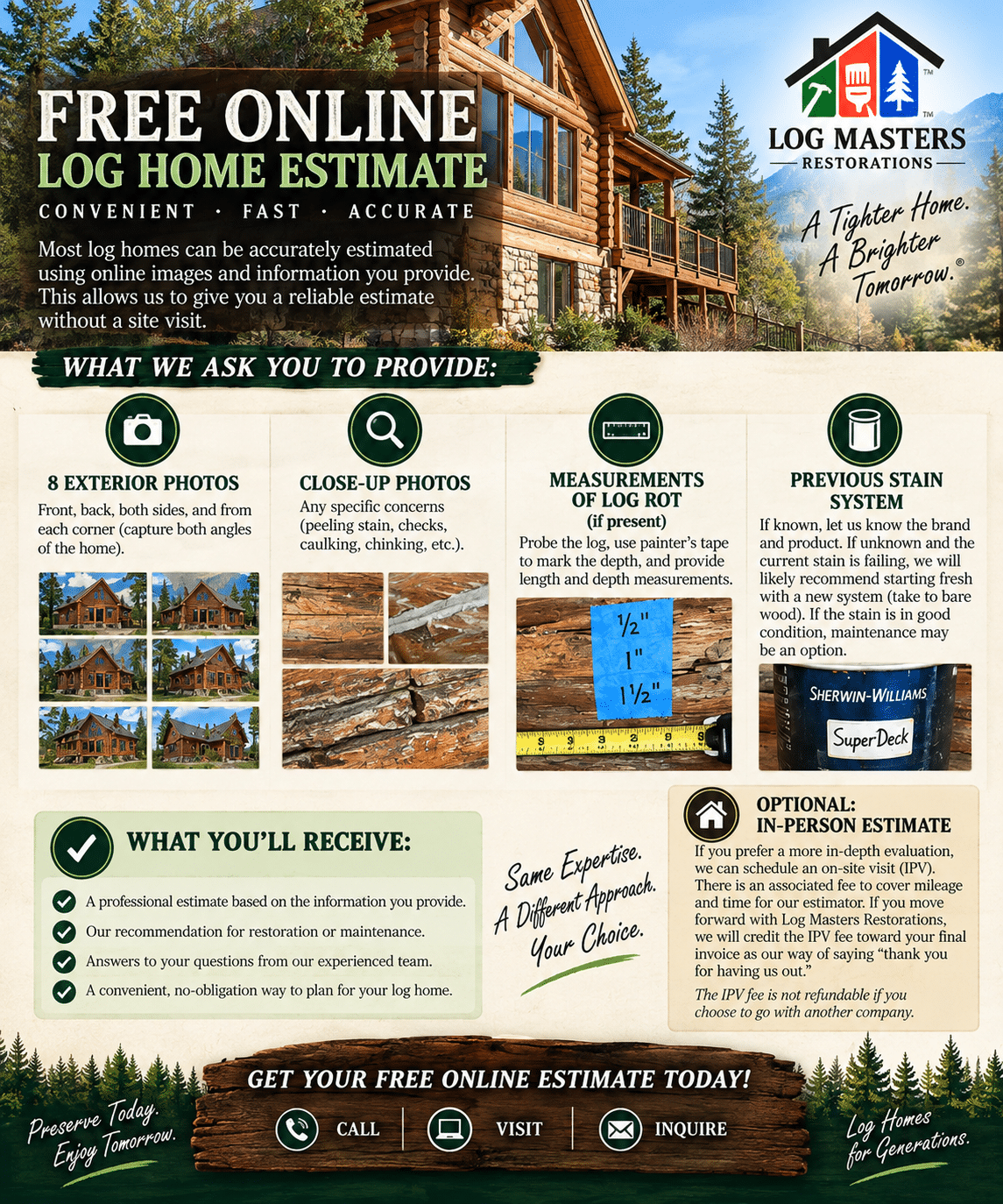
Plan for restoration and maintenance with a free online estimate based on your photos and project details.
Financing Log Homes
Buying a log home does not automatically require a specialty lender. Conventional mortgages may be available, and eligible buyers may also qualify for FHA, VA, or USDA financing. Approval depends on the borrower, the property, the loan program, and the lender’s requirements.
For log homes, two important considerations are whether the appraisal can support the purchase price and whether the lender has additional rules for log or timber construction. Ask your bank, credit union, or mortgage broker about these requirements early in your search.
If you are building a new log home, ask your builder about lenders they have worked with and the construction financing options available.
Where to Start Your Lender Search
Start by asking your bank, credit union, or mortgage broker whether they finance log homes. A lender experienced with log or timber construction can also be a helpful resource.
The lenders listed below are starting points for your search, rather than your only financing options. Contact each lender directly to confirm its current loan programs, service areas, and requirements for your property.
Lenders’ POV on Log Homes
When reviewing a log home, lenders consider the borrower’s qualifications, the property’s condition, and whether the appraisal supports its value. Log construction alone does not automatically prevent mortgage approval.
An appraisal can require additional research when similar homes have sold infrequently in the area. For conventional loans under Fannie Mae guidelines, comparable sales don’t all have to be log homes, but the appraiser must have enough reliable market information to support the valuation.
Some lenders also have additional requirements or restrictions for log and timber homes. If a lender declines the property, ask whether it’s due to its lending policy, the appraisal, or the loan program’s requirements. That explanation can help you determine whether another lender or financing option is worth exploring.
Renovation Financing for a Log Home That Needs Work
If the log home you want to buy needs repairs, ask your lender about renovation financing. An FHA 203(k) loan or a conventional renovation loan, such as Fannie Mae’s HomeStyle Renovation mortgage, may allow eligible buyers to combine the purchase price and approved repair costs into one mortgage. This can reduce the need to find separate cash for repairs after closing.
Start with an independent log-home inspection to identify the property’s condition and repair needs. Your lender can then explain what written contractor estimates and project details are required.
Ask specifically whether needed log replacement, chinking, sealing, or finish restoration qualifies. Repairs, contractors, funding arrangements, and completion deadlines must meet the lender’s and loan program’s requirements, so confirm those details before including restoration costs in your financing plan.
Insuring Log Homes
Insurance availability and cost for a log home depend on the property’s location, condition, replacement cost, and the insurer’s requirements. Remote locations and wildfire exposure can make coverage harder to find. An independent insurance broker familiar with log homes may help you compare options.
Start exploring insurance as soon as you identify a home you are seriously considering. Request property-specific quotes early, ideally alongside your inspection and financing review, so you can include the cost in your budget and address any coverage requirements.
Before closing, your lender will generally require proof of acceptable homeowners insurance, such as an insurance binder or policy documentation. Ask your loan officer exactly what documents are needed and when coverage must begin. A quote alone does not mean coverage is in place.
Where to Start Your Insurance Search
Ask your current insurance agent or an independent broker about coverage for the specific log home you are considering. The companies listed below are starting points for inquiries. Availability varies by location, property condition, and each insurer’s current requirements, so confirm coverage directly rather than assuming a company insures every log home.
- State Farm
- SafeCo
- Farmers
- USAA
What Insurers Consider When Covering a Log Home
Insurers consider the cost to repair or rebuild the home, its condition, local disaster risks, and its claims history when evaluating coverage. Replacing logs or restoring specialized finishes may require experienced contractors, making an accurate replacement-cost estimate important.
Ask your agent whether the proposed coverage accounts for your home’s log construction and what exclusions, deductibles, or property requirements apply. Keep records of inspections, maintenance, and completed repairs to help document the home’s condition.
Keep Up with Professional Log Home Maintenance
Homeowners insurance is not a substitute for routine log-home maintenance. Damage caused by wear, deterioration, or neglected maintenance is generally excluded, although coverage depends on your policy and the cause of the damage. Ask your agent to explain how your policy addresses rot, water damage, and previous repairs.
Regularly check the stain, chinking, caulking, gutters, and drainage, and address signs of moisture problems promptly. Keep dated photos, invoices, and records of completed maintenance and repairs.
Log Masters Restorations can evaluate your home’s restoration and maintenance needs and provide an estimate for recommended work. This evaluation helps you plan for upkeep; it does not replace an independent buyer inspection or determine insurance coverage.
Is Log Home Restoration Expensive?
Builder’s Risk Insurance
Before construction or substantial restoration begins, discuss the planned work with your insurance agent and, if applicable, your lender. Ask whether your homeowners policy provides appropriate coverage during the project or whether you need builder’s risk insurance or another coverage adjustment.
Builder’s risk insurance can cover specified property and building materials against covered losses during construction or renovation. Coverage varies, so confirm whether the existing home, new work, and materials are included, who will obtain the policy, and when coverage begins and ends.
Also request current certificates of insurance from your contractor showing general liability and applicable workers’ compensation coverage. These policies serve different purposes from builder’s risk insurance. Being listed as a certificate holder provides documentation; it does not automatically make you an additional insured under the contractor’s policy.
Additional Considerations
Financing and insurance are only part of preparing to buy an existing log home. Review its maintenance history, arrange an independent inspection by an inspector experienced in log homes, and budget for immediate repairs and ongoing care.
Our Buying an Existing Log Home article explains what to look for in the logs, chinking, stain, roof, and drainage, and why a specialized inspection matters. Log Masters Restorations can also evaluate anticipated restoration and maintenance work to help you understand those costs. Our evaluation complements an independent buyer inspection; it does not replace one.
Conclusion
Financing and insuring a log home starts with early planning. Explore standard mortgage options, confirm your lender’s requirements for the property, and ask about renovation financing if repairs are needed. Begin shopping for insurance alongside your inspection and financing review so coverage availability and cost are part of your decision.
Budget for both immediate restoration and ongoing maintenance. An independent log-home inspection and a restoration evaluation serve different purposes, but together they can help you understand the home’s condition and anticipated work.
With appropriate care, a log home can provide enjoyment for generations. Read our Log Home Durability article to learn more about protecting its long-term condition.
Different Styles of Log Homes to Fit Your Budget
We Want to Hear From You
Let other readers know where you succeeding in getting your log home insurance and financing by commenting below.